iscc-usearch




Larger-than-RAM writable HNSW indexes, and variable-length binary vector search.
Introduction
iscc-usearch is a Python library that extends USearch - a
high-performance HNSW library adopted by
ClickHouse, LangChain, and others - with three independent capabilities:
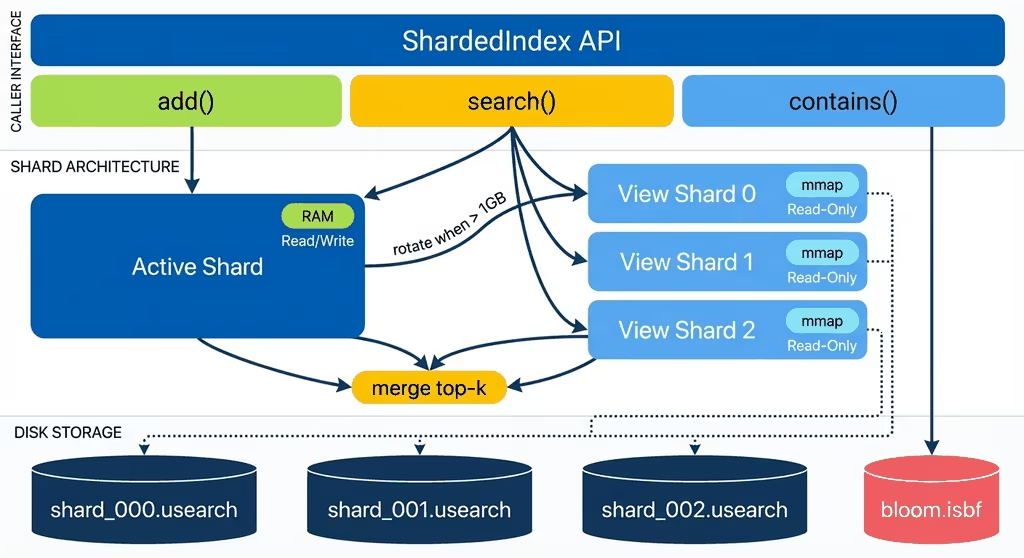
Sharded HNSW indexes (ShardedIndex) keep a single active shard in RAM for writes while
completed shards are memory-mapped for reads. Works with any vector type and metric USearch
supports, including user-defined distance functions. Insert throughput stays consistent and memory
stays bounded as the index grows to billions of vectors.
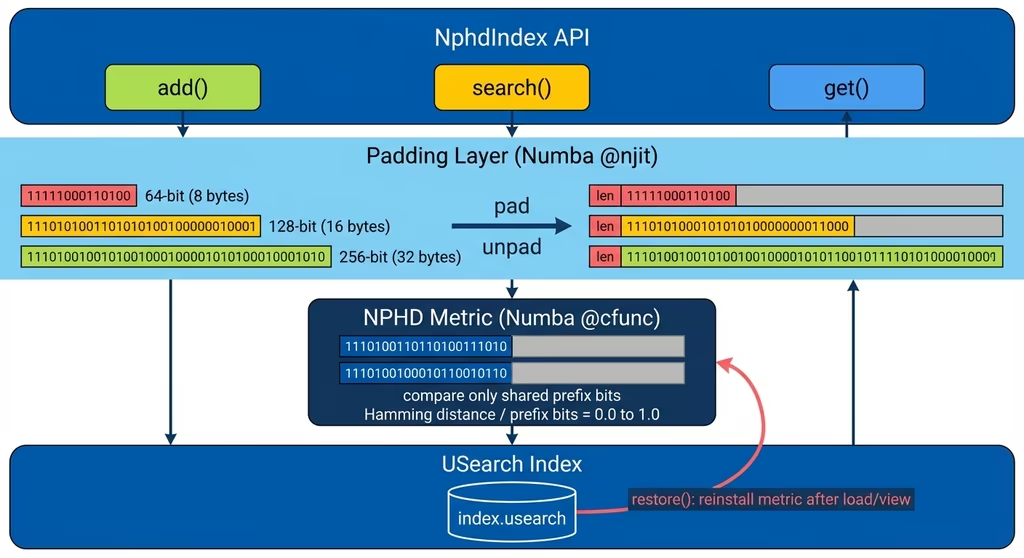
Normalized Prefix Hamming Distance (NphdIndex, ShardedNphdIndex) compares binary vectors
of mixed bit-lengths - a 64-bit query finds nearest neighbors among 256-bit vectors with
comparable distances. Purpose-built for ISCC (ISO 24138) content
fingerprints, also applicable to Matryoshka embeddings,
perceptual hashes, and locality-sensitive hashing.
128-bit UUID keys (ShardedIndex128, ShardedNphdIndex128) extend the key space from 64-bit
integers to 128-bit bytes(16) keys. Useful when your identifiers are UUIDs, 128-bit hashes, or
structured multi-part keys that don't fit in a uint64.
Key features:
- Bounded memory - only one shard in RAM at a time, the rest memory-mapped
- Billions of vectors - sharded indexes scale well beyond single-machine RAM
- Full CRUD - add, remove, upsert, compact, and dirty-counter-driven flush across all index variants
- Mixed bit-lengths - 64-bit and 256-bit vectors coexist in the same index
- 128-bit keys -
bytes(16)UUID keys when 64-bit integers are not enough - Any distance metric - user-defined metrics via USearch's plugin system
- Fast - inherits USearch's HNSW engine, benchmarked at 10x the throughput of FAISS
Which index class?
| Class | Var-len | Keys | Shards | Use when... |
|---|---|---|---|---|
NphdIndex |
✓ | uint64 | — | Binary variable-length, fits in RAM |
ShardedIndex |
— | uint64 | ✓ | Exceeds RAM, any metric |
ShardedIndex128 |
— | 128-bit | ✓ | Same, with 128-bit keys |
ShardedNphdIndex |
✓ | uint64 | ✓ | Binary variable-length, exceeds RAM |
ShardedNphdIndex128 |
✓ | 128-bit | ✓ | Binary variable-length, 128-bit keys |
See the architecture overview for the full class hierarchy.
Quick start
import numpy as np
from iscc_usearch import NphdIndex

index = NphdIndex(max_dim=256)

# Mix 64-bit and 128-bit vectors in the same index
index.add(1, np.array([255, 128, 64, 32, 16, 8, 4, 2], dtype=np.uint8))
index.add(2, np.array([255, 128, 64, 32, 16, 8, 4, 2, 1, 0, 255, 128, 64, 32, 16, 8], dtype=np.uint8))

# Search with a 64-bit query - NPHD compares the common prefix
query = np.array([255, 128, 64, 32, 16, 8, 4, 2], dtype=np.uint8)
matches = index.search(query, count=2)

print(matches.keys)  # Nearest neighbor keys
print(matches.distances)  # NPHD distances in [0.0, 1.0]
import numpy as np
from iscc_usearch import ShardedIndex

# Shards are stored in a directory on disk
index = ShardedIndex(ndim=64, path="my_index", dtype="f32")

# Add vectors - shards rotate automatically when size limit is reached
keys = list(range(1000))
vectors = np.random.rand(1000, 64).astype(np.float32)
index.add(keys, vectors)

# Search across all shards
matches = index.search(vectors[0], count=10)

print(matches.keys)  # Nearest neighbor keys
print(matches.distances)  # Cosine distances
Architecture
ShardedIndex architecture
NphdIndex architecture
Documentation
-
Tutorials - Learn the basics
Hands-on guides from installation to working code.
-
How-to guides - Solve specific problems
Recipes for persistence, sharding, upsert, and bloom filters.
-
Explanation - Understand the design
Background on NPHD, architecture, sharding, and performance.
-
Reference - API details
Auto-generated API documentation for all public classes.
Development & Contributing - Dev setup, testing, and contribution guidelines.